


Management
Management
Lesson 7 : Position Sizing
Lesson 7 : Position Sizing
Lesson 7 : Position Sizing
Beginner
Beginner
4 min
4 min
Risk Management Basics
Risk Management Basics
Risk Management Basics
Risk management can appear complex, with many factors influencing how much should be risked on a per-trade basis. This lesson will establish the foundation.
Risk management can appear complex, with many factors influencing how much should be risked on a per-trade basis. This lesson will establish the foundation.
Risk management can appear complex, with many factors influencing how much should be risked on a per-trade basis. This lesson will establish the foundation.
The baseline rule is simple. Risk management must align with the data of the system in order to maximize winning trades while protecting the downside. The priority is to always account for the worst-case scenario.
The baseline rule is simple. Risk management must align with the data of the system in order to maximize winning trades while protecting the downside. The priority is to always account for the worst-case scenario.
The baseline rule is simple. Risk management must align with the data of the system in order to maximize winning trades while protecting the downside. The priority is to always account for the worst-case scenario.
What does this mean? The worst-case scenario is defined as the maximum number of consecutive losing trades recorded over a larger sample size. While this number can be estimated through backtesting, the most reliable source is live trade data that has been journaled and reviewed. The account must be structured so that, even if this worst-case scenario repeats, enough capital remains to recover and move out of drawdown. Trading is survival first, and this principle ensures protection when probabilities temporarily work against you.
What does this mean? The worst-case scenario is defined as the maximum number of consecutive losing trades recorded over a larger sample size. While this number can be estimated through backtesting, the most reliable source is live trade data that has been journaled and reviewed. The account must be structured so that, even if this worst-case scenario repeats, enough capital remains to recover and move out of drawdown. Trading is survival first, and this principle ensures protection when probabilities temporarily work against you.
What does this mean? The worst-case scenario is defined as the maximum number of consecutive losing trades recorded over a larger sample size. While this number can be estimated through backtesting, the most reliable source is live trade data that has been journaled and reviewed. The account must be structured so that, even if this worst-case scenario repeats, enough capital remains to recover and move out of drawdown. Trading is survival first, and this principle ensures protection when probabilities temporarily work against you.
Risk Management Example
Risk Management Example
Risk Management Example
For example, if a trader records a maximum of five consecutive losses over a 100 trade sample, and there is $5,000 available between the current balance and the maximum drawdown, risk should be sized accordingly. Dollar risk per trade could range from $750 on the higher end to $500 on the lower end. This would leave a buffer of $1,250 to $2,500 to work out of drawdown in a worst case scenario. Within this framework, the trader retains flexibility to lean more conservative or more aggressive based on personal experience, as long as the core rule is respected.
For example, if a trader records a maximum of five consecutive losses over a 100 trade sample, and there is $5,000 available between the current balance and the maximum drawdown, risk should be sized accordingly. Dollar risk per trade could range from $750 on the higher end to $500 on the lower end. This would leave a buffer of $1,250 to $2,500 to work out of drawdown in a worst case scenario. Within this framework, the trader retains flexibility to lean more conservative or more aggressive based on personal experience, as long as the core rule is respected.
For example, if a trader records a maximum of five consecutive losses over a 100 trade sample, and there is $5,000 available between the current balance and the maximum drawdown, risk should be sized accordingly. Dollar risk per trade could range from $750 on the higher end to $500 on the lower end. This would leave a buffer of $1,250 to $2,500 to work out of drawdown in a worst case scenario. Within this framework, the trader retains flexibility to lean more conservative or more aggressive based on personal experience, as long as the core rule is respected.
Fixed Point Risk
Fixed Point Risk
Fixed Point Risk
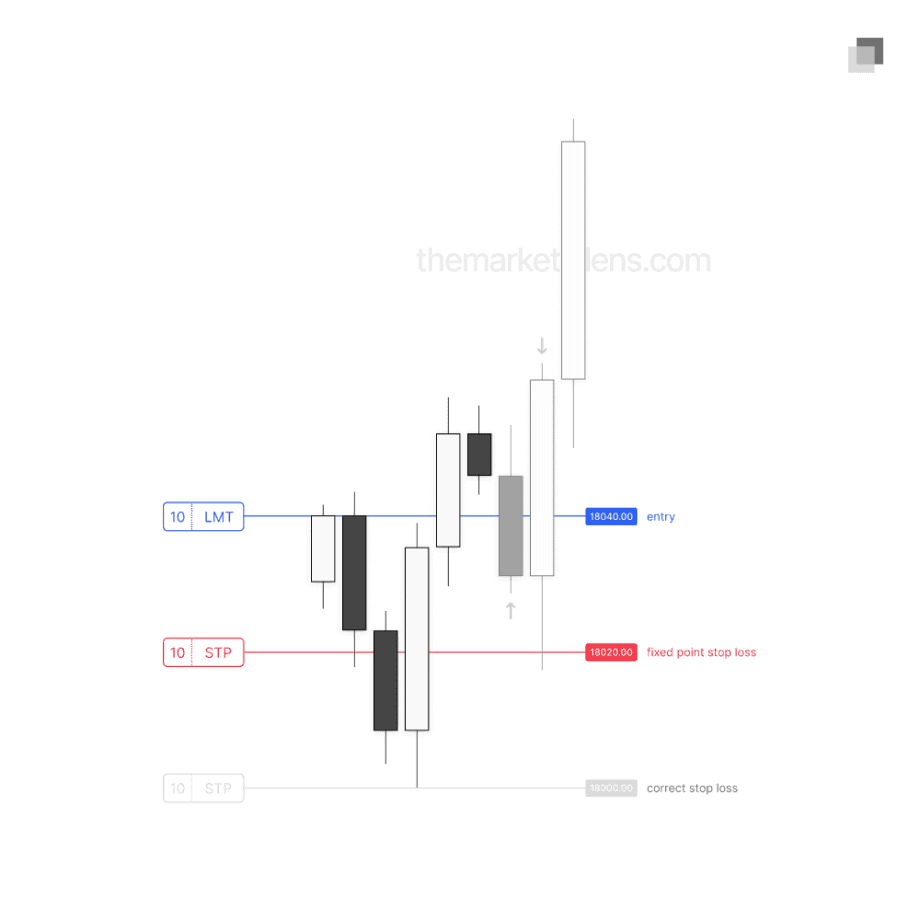
Fixed point risk refers to placing a stop loss at a predetermined number of points regardless of the trade setup. For example, applying a fixed 20-point stop loss to every trade. This is a mistake to avoid because the size and placement of a stop loss are entirely dependent on the specific trade and the current market conditions. The stop loss must always reflect the true invalidation point of the trade while accounting for the level of volatility in the market.
Fixed point risk refers to placing a stop loss at a predetermined number of points regardless of the trade setup. For example, applying a fixed 20-point stop loss to every trade. This is a mistake to avoid because the size and placement of a stop loss are entirely dependent on the specific trade and the current market conditions. The stop loss must always reflect the true invalidation point of the trade while accounting for the level of volatility in the market.
Fixed point risk refers to placing a stop loss at a predetermined number of points regardless of the trade setup. For example, applying a fixed 20-point stop loss to every trade. This is a mistake to avoid because the size and placement of a stop loss are entirely dependent on the specific trade and the current market conditions. The stop loss must always reflect the true invalidation point of the trade while accounting for the level of volatility in the market.
A common outcome of fixed point risk is being unnecessarily stopped out. The trade fails not because the setup was invalid, but because the stop loss was set arbitrarily. In contrast, when the stop loss is placed correctly at the true invalidation point, the trade is allowed room to work and can still play out in favor.
A common outcome of fixed point risk is being unnecessarily stopped out. The trade fails not because the setup was invalid, but because the stop loss was set arbitrarily. In contrast, when the stop loss is placed correctly at the true invalidation point, the trade is allowed room to work and can still play out in favor.
A common outcome of fixed point risk is being unnecessarily stopped out. The trade fails not because the setup was invalid, but because the stop loss was set arbitrarily. In contrast, when the stop loss is placed correctly at the true invalidation point, the trade is allowed room to work and can still play out in favor.
Fixed Dollar Risk
Fixed Dollar Risk
Fixed Dollar Risk
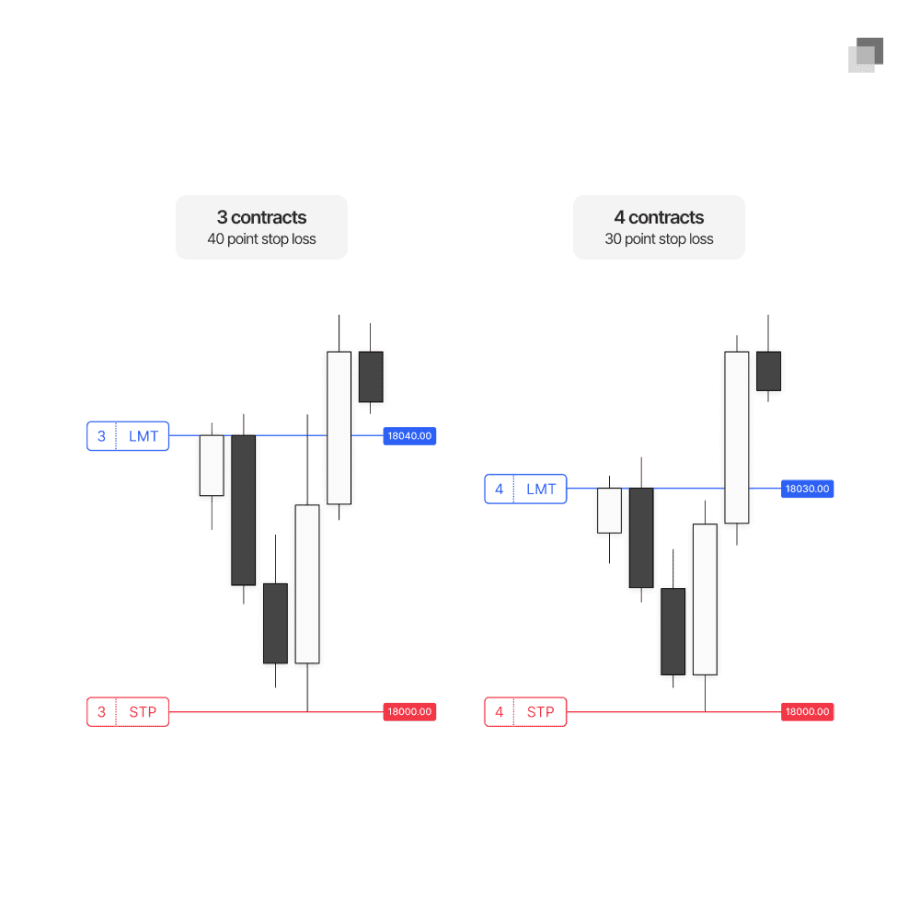
Fixed dollar risk is when the stop loss is placed at the correct invalidation point for the trade, and the position size is adjusted to a predetermined dollar amount. For example, if the required stop loss is 40 points, the entry may be taken with three contracts. If the required stop loss is 30 points, the entry may be taken with four contracts. In both cases, the dollar risk remains fixed at $2,400 because the amount of contracts is adjusted to the stop loss distance.
Fixed dollar risk is when the stop loss is placed at the correct invalidation point for the trade, and the position size is adjusted to a predetermined dollar amount. For example, if the required stop loss is 40 points, the entry may be taken with three contracts. If the required stop loss is 30 points, the entry may be taken with four contracts. In both cases, the dollar risk remains fixed at $2,400 because the amount of contracts is adjusted to the stop loss distance.
Fixed dollar risk is when the stop loss is placed at the correct invalidation point for the trade, and the position size is adjusted to a predetermined dollar amount. For example, if the required stop loss is 40 points, the entry may be taken with three contracts. If the required stop loss is 30 points, the entry may be taken with four contracts. In both cases, the dollar risk remains fixed at $2,400 because the amount of contracts is adjusted to the stop loss distance.

The standard for trading education and guidance
2026 The Market Lens - All Rights Reserved
The standard for trading education and guidance
2026 The Market Lens - All Rights Reserved
The standard for trading education and guidance