


Entry
Entry
Lesson 8 : Pyramid Entries
Lesson 8 : Pyramid Entries
Lesson 8 : Pyramid Entries
Advanced
Advanced
8 min
8 min
Pyramid Entry Example
Pyramid Entry Example
Pyramid Entry Example
Pyramiding a position refers to adding contracts to an open trade that is already moving in profit. This approach allows size to be increased on a winning position without raising the baseline dollar risk. Pyramid entries are optional and will not appear in every trade, but when they do, they can be a valuable tool for scaling profitable positions.
Pyramiding a position refers to adding contracts to an open trade that is already moving in profit. This approach allows size to be increased on a winning position without raising the baseline dollar risk. Pyramid entries are optional and will not appear in every trade, but when they do, they can be a valuable tool for scaling profitable positions.
Pyramiding a position refers to adding contracts to an open trade that is already moving in profit. This approach allows size to be increased on a winning position without raising the baseline dollar risk. Pyramid entries are optional and will not appear in every trade, but when they do, they can be a valuable tool for scaling profitable positions.
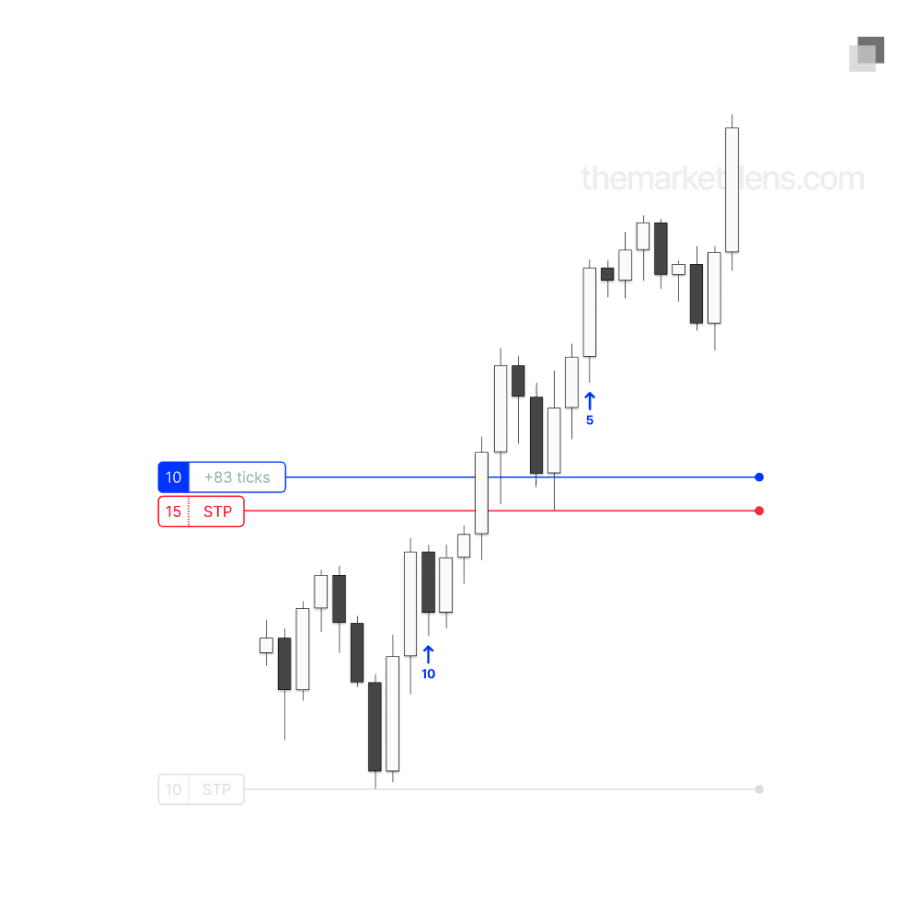
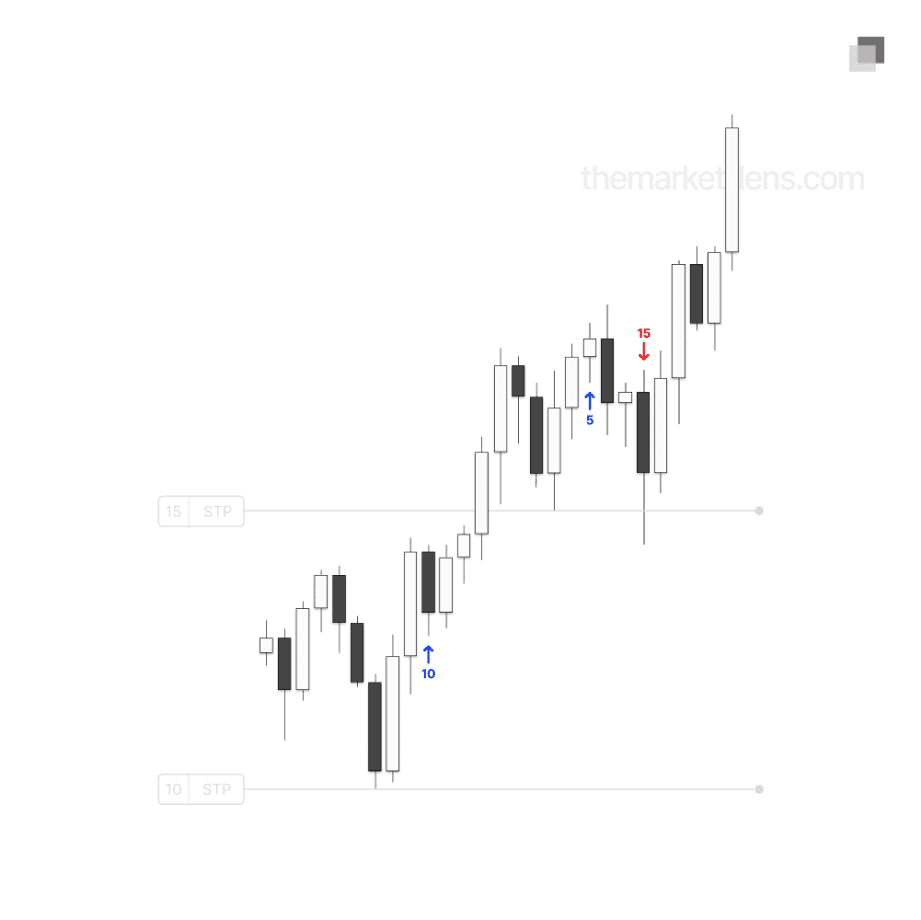
Before addressing the details, below is an example of pyramid entries being executed:
Before addressing the details, below is an example of pyramid entries being executed:
Before addressing the details, below is an example of pyramid entries being executed:
An initial entry is taken with a stop loss placed in the market to define the idea
Price moves in the intended direction, breaking away from the initial entry
Position is added to once a new valid continuation signature is confirmed
Stop loss is trailed to the new invalidation point to reduce risk if stopped out
Trade plays out with larger size, creating the opportunity to begin scaling profits
An initial entry is taken with a stop loss placed in the market to define the idea
Price moves in the intended direction, breaking away from the initial entry
Position is added to once a new valid continuation signature is confirmed
Stop loss is trailed to the new invalidation point to reduce risk if stopped out
Trade plays out with larger size, creating the opportunity to begin scaling profits
An initial entry is taken with a stop loss placed in the market to define the idea
Price moves in the intended direction, breaking away from the initial entry
Position is added to once a new valid continuation signature is confirmed
Stop loss is trailed to the new invalidation point to reduce risk if stopped out
Trade plays out with larger size, creating the opportunity to begin scaling profits
When to Pyramid Entry
When to Pyramid Entry
When to Pyramid Entry
Pyramid entries follow the exact same criteria as any initial entry. This factor does not change. What does change are the conditions that make them valid to apply.
Pyramid entries follow the exact same criteria as any initial entry. This factor does not change. What does change are the conditions that make them valid to apply.
Pyramid entries follow the exact same criteria as any initial entry. This factor does not change. What does change are the conditions that make them valid to apply.
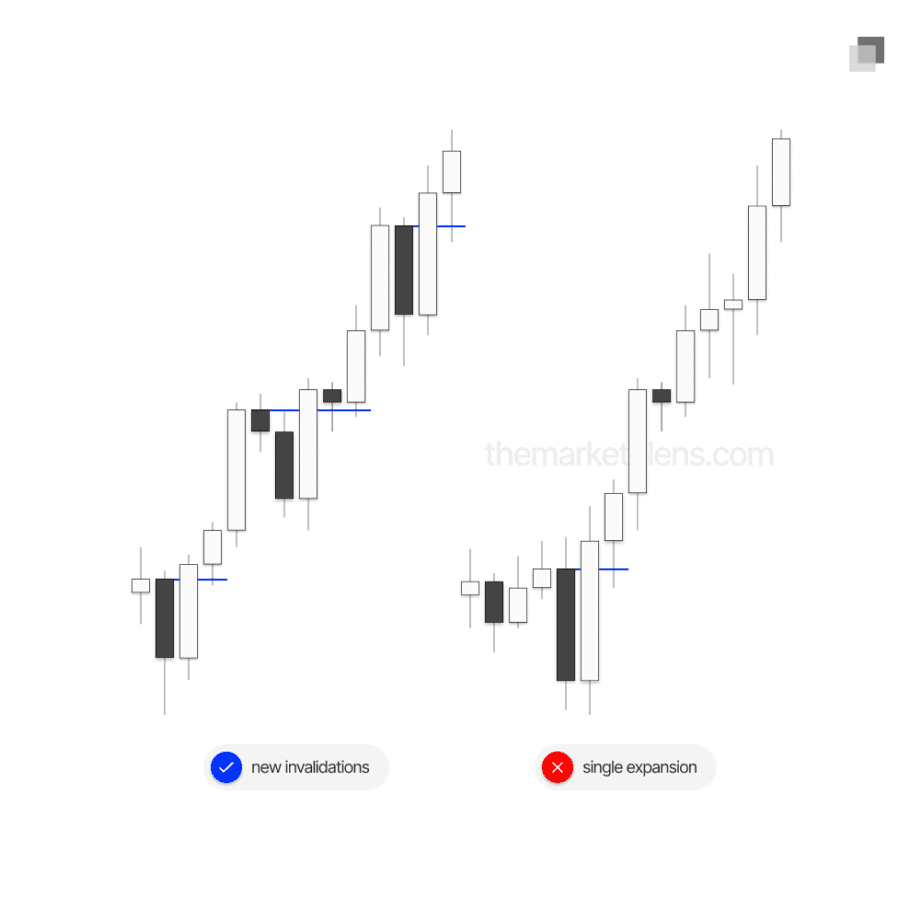
Pyramid entries are only valid when price forms a new continuation signature after the initial entry. Additional contracts can then be added, which will move the average up when long and down when short. The original stop loss is trailed to the invalidation point of the new signature being added to. This is why the same quality and confluence demanded from any entry must also be present for pyramid entries, since the trade is now protected by the trailed stop. A practical mental rule is that if an initial position would not be taken on the signature, then a pyramid entry should not be taken either.
Pyramid entries are only valid when price forms a new continuation signature after the initial entry. Additional contracts can then be added, which will move the average up when long and down when short. The original stop loss is trailed to the invalidation point of the new signature being added to. This is why the same quality and confluence demanded from any entry must also be present for pyramid entries, since the trade is now protected by the trailed stop. A practical mental rule is that if an initial position would not be taken on the signature, then a pyramid entry should not be taken either.
Pyramid entries are only valid when price forms a new continuation signature after the initial entry. Additional contracts can then be added, which will move the average up when long and down when short. The original stop loss is trailed to the invalidation point of the new signature being added to. This is why the same quality and confluence demanded from any entry must also be present for pyramid entries, since the trade is now protected by the trailed stop. A practical mental rule is that if an initial position would not be taken on the signature, then a pyramid entry should not be taken either.
Pyramid entries must also occur before the full expansion of the daily candle is complete. There must be sufficient range left to capitalize on and scale from. Otherwise, the market is more likely to reverse or consolidate, making the pyramid entry unnecessary risk.
Pyramid entries must also occur before the full expansion of the daily candle is complete. There must be sufficient range left to capitalize on and scale from. Otherwise, the market is more likely to reverse or consolidate, making the pyramid entry unnecessary risk.
Pyramid entries must also occur before the full expansion of the daily candle is complete. There must be sufficient range left to capitalize on and scale from. Otherwise, the market is more likely to reverse or consolidate, making the pyramid entry unnecessary risk.
Adding Contracts
Adding Contracts
Adding Contracts
There is the technical aspect of pyramid entries, but there is also a risk management element. This is one of the most dynamic areas of trade and risk management. When a pyramid entry is taken, three moving parts are involved.
There is the technical aspect of pyramid entries, but there is also a risk management element. This is one of the most dynamic areas of trade and risk management. When a pyramid entry is taken, three moving parts are involved.
There is the technical aspect of pyramid entries, but there is also a risk management element. This is one of the most dynamic areas of trade and risk management. When a pyramid entry is taken, three moving parts are involved.
Position size increases, the average position is adjusted, and the stop loss is trailed.
Position size increases, the average position is adjusted, and the stop loss is trailed.
Position size increases, the average position is adjusted, and the stop loss is trailed.
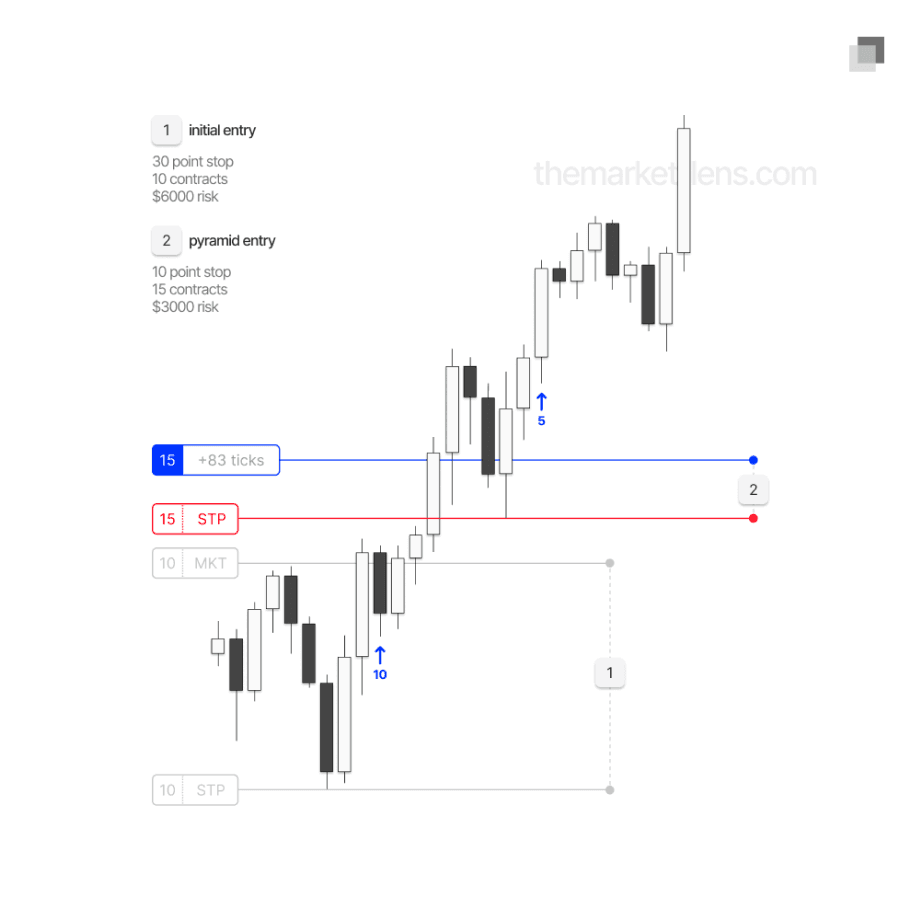
Each additional contract must be added with these factors in mind to ensure risk remains controlled. The graphic below displays an example of controlling risk while taking a pyramid entry with NQ contracts at $20 per point. The total position size increases while the baseline dollar risk becomes reduced.
Each additional contract must be added with these factors in mind to ensure risk remains controlled. The graphic below displays an example of controlling risk while taking a pyramid entry with NQ contracts at $20 per point. The total position size increases while the baseline dollar risk becomes reduced.
Each additional contract must be added with these factors in mind to ensure risk remains controlled. The graphic below displays an example of controlling risk while taking a pyramid entry with NQ contracts at $20 per point. The total position size increases while the baseline dollar risk becomes reduced.
Average Adjustments
Average Adjustments
Average Adjustments
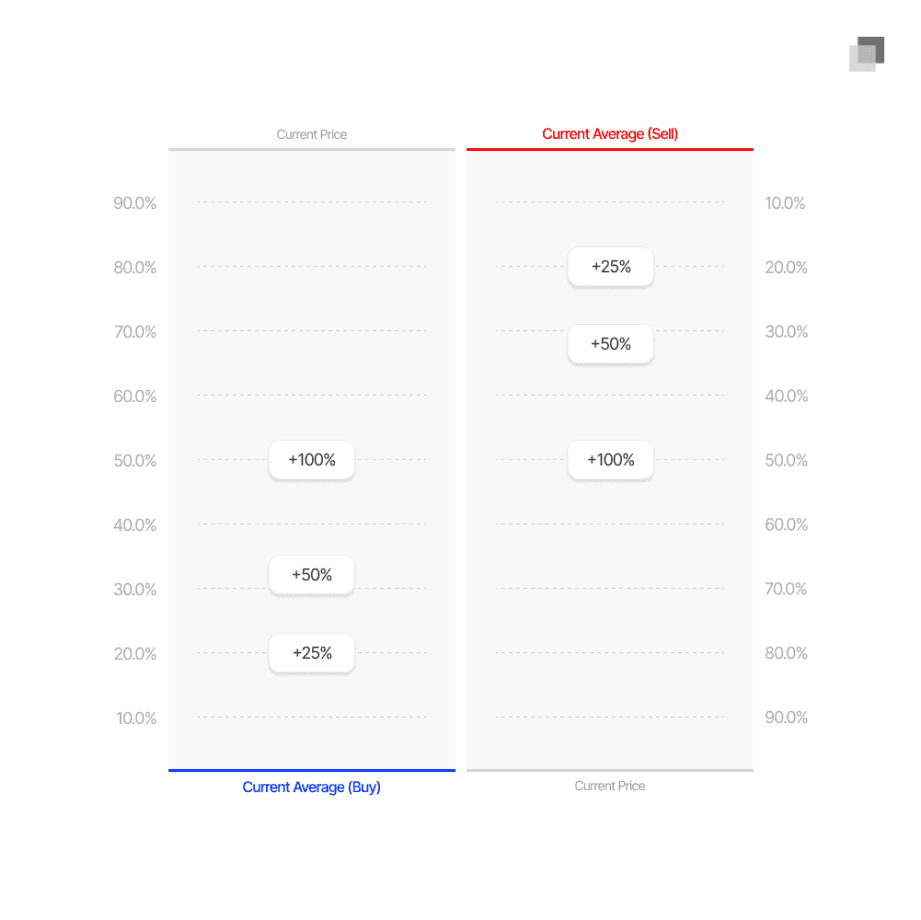
The following is a generalized guide to understand how adding contracts affects the position average:
The following is a generalized guide to understand how adding contracts affects the position average:
The following is a generalized guide to understand how adding contracts affects the position average:
If position size increases by 100 percent, the average will move halfway between the initial position average and the current fill price
If position size increases by 50 percent, the average will move one-third of the way between the initial position average and the current fill price
If position size increases by 25 percent, the average will move one-fifth of the way between the initial position average and the current fill price
If position size increases by 100 percent, the average will move halfway between the initial position average and the current fill price
If position size increases by 50 percent, the average will move one-third of the way between the initial position average and the current fill price
If position size increases by 25 percent, the average will move one-fifth of the way between the initial position average and the current fill price
If position size increases by 100 percent, the average will move halfway between the initial position average and the current fill price
If position size increases by 50 percent, the average will move one-third of the way between the initial position average and the current fill price
If position size increases by 25 percent, the average will move one-fifth of the way between the initial position average and the current fill price
These serve as benchmarks for estimating how the position average will shift. Always round down to the lower tier if the addition does not fall exactly within one of the listed percentages. This ensures risk remains controlled. Preserving downside protection is more important over time than being caught in an overleveraged position.
These serve as benchmarks for estimating how the position average will shift. Always round down to the lower tier if the addition does not fall exactly within one of the listed percentages. This ensures risk remains controlled. Preserving downside protection is more important over time than being caught in an overleveraged position.
These serve as benchmarks for estimating how the position average will shift. Always round down to the lower tier if the addition does not fall exactly within one of the listed percentages. This ensures risk remains controlled. Preserving downside protection is more important over time than being caught in an overleveraged position.
For those who want to see the math behind how position size impacts the average:
For those who want to see the math behind how position size impacts the average:
For those who want to see the math behind how position size impacts the average:
5 contracts initial + 5 contracts added = 10 contracts. The 5 contracts added make up 50 percent of the new position size
10 contracts initial + 5 contracts added = 15 contracts. The 5 contracts added make up 33 percent of the new position size
20 contracts initial + 5 contracts added = 25 contracts. The 5 contracts added make up 20 percent of the new position size
5 contracts initial + 5 contracts added = 10 contracts. The 5 contracts added make up 50 percent of the new position size
10 contracts initial + 5 contracts added = 15 contracts. The 5 contracts added make up 33 percent of the new position size
20 contracts initial + 5 contracts added = 25 contracts. The 5 contracts added make up 20 percent of the new position size
5 contracts initial + 5 contracts added = 10 contracts. The 5 contracts added make up 50 percent of the new position size
10 contracts initial + 5 contracts added = 15 contracts. The 5 contracts added make up 33 percent of the new position size
20 contracts initial + 5 contracts added = 25 contracts. The 5 contracts added make up 20 percent of the new position size
Once contracts are added and the stop loss is trailed, the new dollar risk on the trade must be recalculated based on the larger position size. In a live market, these calculations need to be made quickly, but never impulsively. Pyramid entries place risk management directly on the line, and decisions must remain controlled and backed by a plan.
Once contracts are added and the stop loss is trailed, the new dollar risk on the trade must be recalculated based on the larger position size. In a live market, these calculations need to be made quickly, but never impulsively. Pyramid entries place risk management directly on the line, and decisions must remain controlled and backed by a plan.
Once contracts are added and the stop loss is trailed, the new dollar risk on the trade must be recalculated based on the larger position size. In a live market, these calculations need to be made quickly, but never impulsively. Pyramid entries place risk management directly on the line, and decisions must remain controlled and backed by a plan.
Benefits and Risk
Benefits and Risk
Benefits and Risk
The risk in pyramiding does not come from the increased size, as that is already controlled when done properly. The true risk lies in attempting pyramid entries and being stopped out on the trailed stop loss while the initial stop loss remains intact and the trade continues in line with the original expectation. Every time a pyramid entry is added and the stop loss is trailed, it introduces another decision that must be correct. This compounding effect makes pyramiding a skill that must be developed gradually and applied with caution.
The risk in pyramiding does not come from the increased size, as that is already controlled when done properly. The true risk lies in attempting pyramid entries and being stopped out on the trailed stop loss while the initial stop loss remains intact and the trade continues in line with the original expectation. Every time a pyramid entry is added and the stop loss is trailed, it introduces another decision that must be correct. This compounding effect makes pyramiding a skill that must be developed gradually and applied with caution.
The risk in pyramiding does not come from the increased size, as that is already controlled when done properly. The true risk lies in attempting pyramid entries and being stopped out on the trailed stop loss while the initial stop loss remains intact and the trade continues in line with the original expectation. Every time a pyramid entry is added and the stop loss is trailed, it introduces another decision that must be correct. This compounding effect makes pyramiding a skill that must be developed gradually and applied with caution.

The standard for trading education and guidance
2026 The Market Lens - All Rights Reserved
The standard for trading education and guidance
2026 The Market Lens - All Rights Reserved
The standard for trading education and guidance